
The Snow Maiden. A European view of Russian antiquity
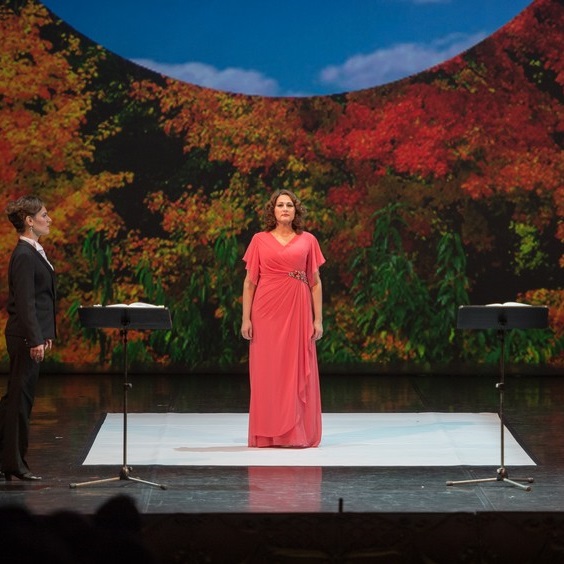
On 23 and 24 December, the Mikhailovsky Theatre will host a concert performance of Nikolay Rimsky-Korsakov’s opera The Snow Maiden. Maria Litke, performing the role of Kupava, shares her impressions of this ‘spring fairy tale’:
“Kupava is a fully formed character who remains almost unchanged throughout the opera in a way which is very archaic”, says the singer. "Her reaction in any situation is easy to predict. If someone falls out of love with her, she’ll cry and fret. If she has a problem she can’t solve, she looks to nature. When there is no one to turn to, she seeks help from the streams and wild animals. In other words, she is a simple, country girl. She is the archetype of a thoroughly ‘unmodern’ woman.
“Contemporary audiences often take works which were created during the Soviet era, such as songs from the films of that period, as being truly Russian. This perception is understandable: life was tough in those days, and Russian folk culture became a kind of caricature of itself. Rimsky-Korsakov’s Snow Maiden contains breathtaking melodies and an authentic heritage whose roots in our culture can be traced back to perhaps even before the Christianization of Rus. It is something primordial, which sits very deeply in our consciousness. It is extremely difficult to grasp, and in order to do so certain preconceptions had to be broken down with this music.
“I’m fascinated by how Dmitri Jurowski, a director with a completely European sense of music, has dealt with this Russian classic. His reading of the text differs from the usual interpretations of Russian operas. In his approach, there is nothing heavy-handed, obscure, or drowned out by the passions of the soul — the things usually taken by foreigners to constitute the Russian style. Jurowski is really changing people’s perceptions with his European approach to Rimsky-Korsakov. His is a delicate and careful Snow Maiden, with evident love for the intricacies of nature. In his hands, the female roles in this opera are full of life. Here, there is no common ground with the primitive view that foreigners often have of Russian women, which offers no middle ground between the tropes of a woman of easy virtue and a silent, fur-clad mystery. There are no nuances in that representation of Russian women. It is as if the maestro is observing a piece of fabric, which he doesn’t want to use for its intended purpose, but rather observe as a rich tapestry of stitches, trying to imagine what was on the seamstress’ mind when she was engrossed in the act of sewing.”