
The Master and Margarita: 40 Years On
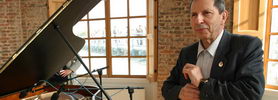
On 9 and 10 July , Vladimir Yurovsky, a great enthusiast when it comes to producing hits in the repertoire, is conducting a birthday concert at the Mikhailovsky Theatre for the classic exponent of the Soviet school of composition, Sergey Slonimsky. The first act of his opera The Master and Margarita, banned immediately after its first performance in St. Petersburg in 1972, will be heard here for the first time in 40 years. For Yurovsky, who as a student in 1989 took part in the Moscow premiere of the opera conducted by his father, it is, one could say, family history. The 80-year-old composer recalls the circumstances which, although long ago, have hardly lost their relevance.
“The idea of writing an opera based on The Master and Margarita occurred to me as soon as the novel came out — I still have the two issues of Moskva magazine in which it was published. While reading the book, I immediately thought of two parallel series of events that could be developed on the operatic stage: the events in Jerusalem in the 1st century AD and the court cases brought by the Soviet authorities against every honest artist, scientist or politician. I was also captivated by the romantic image of Margarita with her pure and selfless love of the Master. The enigma of Woland was revealed to me later. At first, I left out that layer of the novel, having entirely fallen under the spell of the image of Yeshua — a being of infinite goodness, such as there cannot be on Earth. However, Woland, too, is good in his own way. He only punishes crimes and acts which are against human nature.
“The question of the libretto immediately presented itself. I saw The Master and Margarita as an opera of the absurd, in the style of Kharms or Beckett: not nonsense, but action in which a realistic and reliable sequence of events is not essential, in which time can be fluid; for example, the simultaneous annihilation of the Master by the critics, and Golgotha. Sometimes the action unfolds in reverse, starting with the epilogue. So, the epilogue is relocated at the beginning: after Yeshua’s execution, Pontius Pilate begs to be told that there was no execution, that he had only dreamed it. This type of freed action, in which the scenes are not connected by strict chronology, was not welcome in Soviet theatre, and at that time there were also very few such works being produced in the West.
“Yury Dimitrin originally worked on the libretto, and was later joined by Vitaly Fialkovsky. I also made a lot of additions to the libretto myself, lifting part of the text directly from the novel, developing the character of Judas and giving him a whole aria.
“I found the basics of musical drama in Claudio Monteverdi. The Renaissance, pre-Bach model can still be a staple of new drama in music. I wrote the first part of the opera very quickly and had no trouble finding performers: both the singers and the members of Mravinsky’s orchestra were very keen on performing a new work. By the time the premiere of the first part was ready to be performed, the second and third acts were almost finished. Dmitry Shostakovich was very supportive of our work.
“It was a rather strange premiere. The crowd that was attempting to force its way by any means into the small hall inside the House of Composers exceeded the capacity of the hall many times over. Four Lenin Prize winners were in the hall that day — prominent people who understood the role of art: Georgy Tovstonogov, Evgeny Mravinsky (who was in the House of Composers for the first time), David Oistrakh (who sat with the score in his lap) and Gennady Rozhdestvensky, who conducted the premiere. However, it wasn’t they who decided the future of the opera, but the ‘workers of the invisible front’. There were four of them in the hall, but nobody knew them by sight.
“After the premiere, when Rozhdestvensky and I were having supper at his hotel, he told me I should make a copy of the recording by no later than 9:00 am, because at 10:00 am it would be demagnetized. I managed to make the copy, and at precisely 10 o’clock the next morning a call came from the regional committee: performance of the opera was banned. Andrey Petrov was ordered to hold a meeting of the board of the Composers’ Union to condemn the opera and ban it. It was a duty that he found unpleasant, but he fulfilled it. Some senior colleagues spoke on my behalf: Boris Arapov, Lyutsian Prigozhin, Joseph Pustylnik, Israil Finkelstein, Natalia Kotikova, Feodosy Rubtsov (founder of the study of folklore). They would not allow a resolution for the opera to be ‘recognized as ideologically depraved’ be passed, and the city administration was obliged to comply. A decision was made to ban the performance of the opera in musical theatres and the All-Union Agency for Authors’ Rights was ordered not to allow the musical material out of the country, though in fact there had been no enquiries about it from abroad. I kept the manuscript at home so that it would not be confiscated. And that is how the life of the opera was halted for 17 years. The next performance took place only at the height of perestroika, and became possible thanks to Mikhail Yurovsky.
“The Master and Margarita is one of my most serious compositions. I worked on it during my most productive period. The banning of the opera was not the first such instance in my career, nor the last. The same fate befell a number of my other works: the ‘Antiphons’ instrumental quartet, romances to poems by Anna Akhmatova, the cantata ‘Voice from the Choir’ to Alexander Blok’s verses.
“The opera is clearly genetically related to the ‘Antiphons’ quartet, which I wrote in 1968. I used the ‘quantum rhythm system’ in it — just like in folk music, when an ensemble originates not on the basis of counting, and it is impossible to predict when a particular note will begin. The musicians do not count, but instead intone; I even placed the musicians in different parts of the hall so as to bring out the specific quality of each instrument. Then they came together on the stage — the ensemble was formed on the basis of intonation. Incidentally, when ‘Antiphons’ was banned, among my transgressions was that ‘musicians should not walk around the stage’. Another one on the list of grievances, which shames me to repeat out loud, was that ‘the musicians couldn’t play quarter-notes’. The quartet as a whole was characterized as ‘typical Western modernism’.
“I continued developing the ideas I had tried out in the quartet in The Master and Margarita. The musicians in the opera play an enormous role. It is as though the shadow of a particular instrument or group of instruments is attached to a character. One, two, or three monodies correspond to each vocal episode, each arioso structure, as in a Greek tragedy. They either double the vocal melody, sometimes with deviations, or play their own melody – close to the vocal part or contradicting it. I immediately visualized Woland’s retinue as instrumental theatre: the Cat was a piccolo and Koroviev a bassoon. The character of Pilate changes substantially and evolves, so several instruments are used for him. At first he was a pensive clarinet, then became more gloomy and was represented by a bass clarinet an octave lower. Later, when he pronounces the dreadful words of the sentence, the clarinets were replaced by brass instruments, trumpets and trombones. Yeshua was a harp and oboe duet — a trio, to be more precise, as there were two harps with different tunings.
“Later on, when I was continuing work on the second and third acts, I increased the role of the choir, and made ‘Satan’s Ball’, including the episode with Frieda, primarily a ballet scene.
“The banning of The Master and Margarita was a terrible blow for me, but I did not trouble the powers that be with complaints and didn’t burden Dmitry Shostakovich with my problems, though he supported my idea and had a high opinion of my work. At the height of the ‘banning’ plenums and sessions in the late spring of 1972, I happened to meet Joseph Brodsky, who was a friend of mine, on the Field of Mars. It was literally only a few days before his departure to the West. ‘Maybe we could go together’, he said, knowing that I was being hounded out of the Conservatory. ‘But you don’t really want to leave, do you?’ I asked my friend. ‘No’, he replied. ‘I don’t want to’.
“At that time, the novel The Master and Margarita had not yet become a super-popular work, the play at the Taganka Theatre had not yet appeared, and the screen adaptations of the many-paged epic had not yet begun. Andrey Petrov, who had been given the unpleasant task of organizing the ban on my opera at the Composers’ Union, could not have imagined that he would soon be writing the music for a ballet on the same theme.
“The Master and Margarita has now been completely turned into kitsch. Something of the kind happens to every great work – it is inevitable. It attracts a great variety of people from other artistic spheres, and from the endless stage versions the eventual result is ersatz, in which the rich meaning of the novel is reduced to melodrama or circus tricks. But the director of a variety theatre is not responsible! He is simply another victim.
“The conductor Mikhail Yurovsky and I had a conversation on these themes when we happened to be in the same holiday home in Ruza. I described to him in detail the story of the first performance and the banning of my opera. He was very interested, and it was under his baton that the first performance of The Master and Margarita in Moscow took place — in the Great Hall of the Conservatory in 1989. After the Moscow premiere, everyone remarked that the Golgotha scene was similar to Bach’s St. Matthew Passion. The opera was performed in full only in 2000, again conducted by Mikhail Yurovsky That was in Hannover during EXPO-2000; it was performed in German in the German pavilion.
“Vladimir Yurovsky, Mikhail Yurovsky’s son and the Musical Director of the Mikhailovsky Theatre production, was one of the participants in the Moscow premiere. He was a student at the time and was one of a group of dramatic actors who played members of the Moscow Association of Writers (MASSOLIT). In parallel with the high tragedy and Gospel simplicity of Golgotha is the scene in which the critics annihilate the Master’s novel. The guignol and grotesque of this carnage is conveyed by conversational dialogue. Vladimir Yurovsky performed one of those conversational roles”.
OpenSpace.ru (in Russian)