
05.07.2012
‘The Burden of Perfect Pitch’
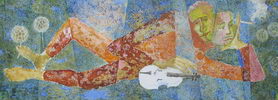
An exhibition of paintings by Tatiana Skorlupkina can be seen in the Fireplace Hall on the Dress Circle level. The display features paintings devoted to music and musicians — a theme the artist is already well familiar with.
Tatiana Skorlupkina received a professional musical education: for several years she played the harp in symphony orchestras in a number of Russian cities. She subsequently graduated from the Graphic Arts Faculty of the Herzen State Pedagogical University in St. Petersburg. Since 1990 she has been a member of the Russian Artists’ Union. Exhibitions of her work have been held in Germany and France, as well as in Russia.
Speaking about her artistic career, Tatiana Skorlupkina noted that “Music and its visual reflection on paper have always existed; drawing and its melody have long captured the imagination”. The paintings in the exhibition feature musicians and musical instruments. The general tonality of the composition is born out of colour — subdued or richly expressed; out of lines that either dominate or are subservient to the colour backdrop; and from the particular technique, similar to Impressionism, in which the work is born from separate brushstrokes, as if from musical chords.
An exhibition of paintings in a musical theatre is an opportunity to take a broad view of art, not restricted by the bell that precedes a performance or the curtain that ends it. This theory of the synthesis of the arts was espoused by Wagner, who considered a theatre to be the ideal setting for the creation of a universal work of art: Gesamtkunstwerk. Wagner was followed by the avant-gardists of the early 20th century in their study of synthetic art. Kandinsky created a system of parallels between colours and sounds, while the composers Schoenberg and Scriabin explored the possibility of adding light and colour to a musical score.
The exhibition continues until the end of the season.
Tatiana Skorlupkina received a professional musical education: for several years she played the harp in symphony orchestras in a number of Russian cities. She subsequently graduated from the Graphic Arts Faculty of the Herzen State Pedagogical University in St. Petersburg. Since 1990 she has been a member of the Russian Artists’ Union. Exhibitions of her work have been held in Germany and France, as well as in Russia.
Speaking about her artistic career, Tatiana Skorlupkina noted that “Music and its visual reflection on paper have always existed; drawing and its melody have long captured the imagination”. The paintings in the exhibition feature musicians and musical instruments. The general tonality of the composition is born out of colour — subdued or richly expressed; out of lines that either dominate or are subservient to the colour backdrop; and from the particular technique, similar to Impressionism, in which the work is born from separate brushstrokes, as if from musical chords.
An exhibition of paintings in a musical theatre is an opportunity to take a broad view of art, not restricted by the bell that precedes a performance or the curtain that ends it. This theory of the synthesis of the arts was espoused by Wagner, who considered a theatre to be the ideal setting for the creation of a universal work of art: Gesamtkunstwerk. Wagner was followed by the avant-gardists of the early 20th century in their study of synthetic art. Kandinsky created a system of parallels between colours and sounds, while the composers Schoenberg and Scriabin explored the possibility of adding light and colour to a musical score.
The exhibition continues until the end of the season.