
05.09.2016
LA BOHÈME: The life of an artist.
Svetlana Monchak
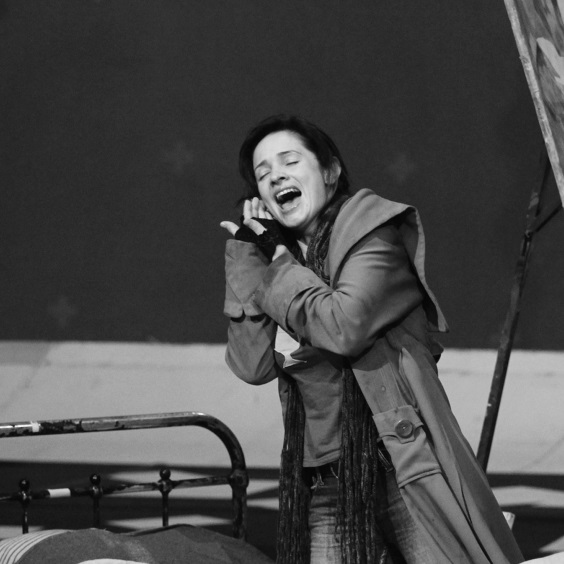
The characters in La Bohème are young and talented, with a love of life that they expect to be reciprocated. The same can be said for almost everyone involved in the upcoming production of the opera at the Mikhailovsky Theatre. Listening to a few of the artists talk freely about it, the personal relationship that they have with the characters and with the story that they will be performing on stage becomes clear.
Svetlana Monchak, soprano, singing the part of Mimi:
"Saint-Exupéry wrote that love — love for a flower for instance — is first and foremost a rejection of all other flowers. I completely agree. Applying this theory, I have come to the conclusion that love is not present in La Bohème.
"Mimi has a plan from day one and one which is made quite clear throughout our performance. She wants to join the bohemian strata. After all, who is she? She makes embroidered floral patterns and decorative silk flowers, which, as she woefully laments, possess no real fragrance. She stands even lower on the conventional social ladder than Rodolfo or Marcello, who have an almost deity-like stature in her imagination. She sets her sights on one of them and cozies up to him immediately after everybody else has left — this was her plan.
«Mimi does still have some warm feelings towards Rodolfo, but as for Rodolfo himself... Who would leave a loved one simply because they are too lazy to change themselves? He has chosen not to work, something which would have allowed him to earn money to pay for medication, and he tells her, quite literally, ‘My dear, off you go to the Count. I am not able to support you now. You are dying, I cannot watch it happen and there’s nothing I can do to help you.’ I think Rodolfo finds Mimi rather attractive, but he hasn’t prepared himself for complications of this kind. In the end, Mimi does indeed go to the Count, something which would be unthinkable if she had truly loved Rodolfo.
«After Mimi’s death Rodolfo, as expected, cries his heart out over her body, but this had nothing to do with love. Rather, he feels overwhelmed by the weight of being — we are enriched by the experience of each tear shed. He sings her name as she dies before taking his leave to write a novel about it. For him, the experience is poetic. He has never buried anyone before, and no one has ever died in his arms. This new sensation becomes a reason to go on living.»
Svetlana Monchak, soprano, singing the part of Mimi:
"Saint-Exupéry wrote that love — love for a flower for instance — is first and foremost a rejection of all other flowers. I completely agree. Applying this theory, I have come to the conclusion that love is not present in La Bohème.
"Mimi has a plan from day one and one which is made quite clear throughout our performance. She wants to join the bohemian strata. After all, who is she? She makes embroidered floral patterns and decorative silk flowers, which, as she woefully laments, possess no real fragrance. She stands even lower on the conventional social ladder than Rodolfo or Marcello, who have an almost deity-like stature in her imagination. She sets her sights on one of them and cozies up to him immediately after everybody else has left — this was her plan.
«Mimi does still have some warm feelings towards Rodolfo, but as for Rodolfo himself... Who would leave a loved one simply because they are too lazy to change themselves? He has chosen not to work, something which would have allowed him to earn money to pay for medication, and he tells her, quite literally, ‘My dear, off you go to the Count. I am not able to support you now. You are dying, I cannot watch it happen and there’s nothing I can do to help you.’ I think Rodolfo finds Mimi rather attractive, but he hasn’t prepared himself for complications of this kind. In the end, Mimi does indeed go to the Count, something which would be unthinkable if she had truly loved Rodolfo.
«After Mimi’s death Rodolfo, as expected, cries his heart out over her body, but this had nothing to do with love. Rather, he feels overwhelmed by the weight of being — we are enriched by the experience of each tear shed. He sings her name as she dies before taking his leave to write a novel about it. For him, the experience is poetic. He has never buried anyone before, and no one has ever died in his arms. This new sensation becomes a reason to go on living.»