
01.10.2012
For the First Time in Russia: Vera Nemirova
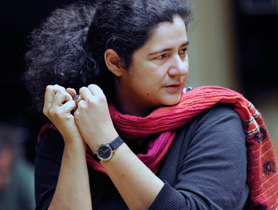
Vera Nemirova, leading opera director and the creator of shows performed on the stages of Germany, Austria, Switzerland, and other European countries, is preparing to stage her first opera in Russia: a performance of Der fliegende Holländer at the Mikhailovsky Theatre, in honour of Wilhelm Richard Wagner’s 200th birthday. Nemirova has a good deal to fit into her short stay in St. Petersburg: she needs to see the city she has long dreamed of visiting, get to know the theatre where she will be working, discuss the concept of the upcoming performance with its musical director, Vasily Petrenko, and give her first-ever interview in Russian. And although she cautions that it is too early to say which show will be her first in Russia, the topic of Der fliegende Holländer comes up constantly.
Vera, you have been familiar with the operatic arts and stage since your early childhood. Is that right?
— Yes, that’s right. My mother, Sonja Nemirova, was an opera singer, a dramatic soprano. She sang the roles of Aida, Tosca, and Leonora in Fidelio. When we moved from Bulgaria to Rostock, a city in northern Germany, the first part she sang there was Senta in Der fliegende Holländer. Now she’s an instructor; she teaches singers and works with me as a dramaturge and consultant. She helps me out a lot. It’s worth noting that it’s been exactly 30 years: she sang the role of Senta in 1983, and now, in the summer of 2013, Der fliegende Holländer will premiere here in St. Petersburg.
Have you ever staged this opera before?
— No, this is the first time, although I’ve done a lot of Wagner. I started with Tannhäuser; this summer was the Frankfurt premiere of Der Ring des Nibelungen, the four-opera cycle. It was a success! Next time, the entire cycle will be staged in February 2013.
A lot of time has gone by very quickly...
— Yes... My father was an opera director, and, of course, I spent my whole childhood with my parents at the theatre. My father happened to work with Shostakovich; he staged Lady Macbeth of the Mtsensk District for the first time in Bulgaria in 1963. The premiere was in Ruse, a small but very beautiful city on the banks of the Danube. There was a festival there at that time called March Music Days; it’s still held today. Shostakovich visited there as a guest and spent 10 days there giving a great deal of advice on the performance. He worked with the singers himself. Our family archive has a lot of photos from that premiere, and a warm recommendation of my father’s staging by Shostakovich. And today it’s very important to me to feel that here, in St. Petersburg, the spirit of Shostakovich is still alive.
When did you first try your hand at directing?
— When we were little, there was no Internet, and TV was a lot different than it is now. And we kids spent a huge amount of time outside. We played together; it was wonderful! It was back then, in Bulgaria, that I put on my first shows: both theatrical and circus shows. We invited our friends, our neighbours, our grandparents. They were all there, and they all loved it! Even now, those memories mean a lot to me. That’s where my roots are, and that’s where my imagination and inspiration come from.
Did you choose fairy tales for your shows?
— I was an author back then too. And now, I’m still partly an author of all my best work. Of course, you have the work itself, but you have to think how to tell the story in a different way so that it grabs the attention of the modern viewer.
What is there more of in the work of a director: imagination and spontaneous discoveries, or technology and precise engineering analysis?
— Both. It’s all needed. A show is made of a lot of things put together. In addition to the direction, the costumes, set, and lighting are very important. And the music, of course. Right now, Vasily Petrenko and I are discussing this upcoming show. We each have our own mental pictures; we’ve both thought and read a lot. And we’re starting with the fact that we’re meeting and talking about all that; we’re discussing it at great length. Sometimes we can talk for three days in a row. Inspiration comes out of that combined analysis. Suddenly, something interesting pops up in our conversation, and draws with it the next fragment — one more twist in the plot. And then we each go back to our own parts of this joint work again. But I’m also always interested in the music. I studied at the Academy of Music Hanns Eisler Berlin, and I can read a musical score. My imagination works when I listen to music, and when my imagination switches on, I draw and write... Everything in me gets activated. Later, everything I’ve come up with gets sorted: I say to myself, this would be good; that’s the right theme.
Right now, the decisions on the upcoming show are only being explored, but still I’ll risk asking: will this be a staging with references to history, or will it be a current reading?
— Absolutely current! For example, Senta, the heroine in the opera, loves pictures. How many people today spend their time on the Internet! Everything they do is virtual, and often incompatible with reality. And when that picture appears in the real world, it might be difficult for them.
So it would be no exaggeration to say that Senta in Der fliegende Holländer will be an Internet-addict?
— Right! Although that’s just an idea for now. We’re still searching; we don’t have anything final pinned down. I’m just talking about it so that young people will know that they can find a lot in opera that surrounds them today in their own lives.
This is your first time working in St. Petersburg. Does the city somehow influence the decisions you make on the show?
— St. Petersburg is a fabulous city. This is my first time here, and I have never seen such wide-open spaces, so much air.
And the proximity to the sea...
— Yes, that is very important. In Der fliegende Holländer, everything must submit to the waves. That is very important to me: I grew up on the Baltic Sea, in Rostock; it seems to me that I am very sensitive to that subject and that I see those tones: murky grey, white, blue...
That’s the colour scheme for the show!
— It could be. An opera about the sea in a maritime city! That inspires me. And this is also important: Der fliegende Holländer was Wagner’s first opera to be staged in Russia. Now it’s returning here once again.
Photo: Wiener Staatsoper GmbH / Axel Zeininger
Vera, you have been familiar with the operatic arts and stage since your early childhood. Is that right?
— Yes, that’s right. My mother, Sonja Nemirova, was an opera singer, a dramatic soprano. She sang the roles of Aida, Tosca, and Leonora in Fidelio. When we moved from Bulgaria to Rostock, a city in northern Germany, the first part she sang there was Senta in Der fliegende Holländer. Now she’s an instructor; she teaches singers and works with me as a dramaturge and consultant. She helps me out a lot. It’s worth noting that it’s been exactly 30 years: she sang the role of Senta in 1983, and now, in the summer of 2013, Der fliegende Holländer will premiere here in St. Petersburg.
Have you ever staged this opera before?
— No, this is the first time, although I’ve done a lot of Wagner. I started with Tannhäuser; this summer was the Frankfurt premiere of Der Ring des Nibelungen, the four-opera cycle. It was a success! Next time, the entire cycle will be staged in February 2013.
A lot of time has gone by very quickly...
— Yes... My father was an opera director, and, of course, I spent my whole childhood with my parents at the theatre. My father happened to work with Shostakovich; he staged Lady Macbeth of the Mtsensk District for the first time in Bulgaria in 1963. The premiere was in Ruse, a small but very beautiful city on the banks of the Danube. There was a festival there at that time called March Music Days; it’s still held today. Shostakovich visited there as a guest and spent 10 days there giving a great deal of advice on the performance. He worked with the singers himself. Our family archive has a lot of photos from that premiere, and a warm recommendation of my father’s staging by Shostakovich. And today it’s very important to me to feel that here, in St. Petersburg, the spirit of Shostakovich is still alive.
When did you first try your hand at directing?
— When we were little, there was no Internet, and TV was a lot different than it is now. And we kids spent a huge amount of time outside. We played together; it was wonderful! It was back then, in Bulgaria, that I put on my first shows: both theatrical and circus shows. We invited our friends, our neighbours, our grandparents. They were all there, and they all loved it! Even now, those memories mean a lot to me. That’s where my roots are, and that’s where my imagination and inspiration come from.
Did you choose fairy tales for your shows?
— I was an author back then too. And now, I’m still partly an author of all my best work. Of course, you have the work itself, but you have to think how to tell the story in a different way so that it grabs the attention of the modern viewer.
What is there more of in the work of a director: imagination and spontaneous discoveries, or technology and precise engineering analysis?
— Both. It’s all needed. A show is made of a lot of things put together. In addition to the direction, the costumes, set, and lighting are very important. And the music, of course. Right now, Vasily Petrenko and I are discussing this upcoming show. We each have our own mental pictures; we’ve both thought and read a lot. And we’re starting with the fact that we’re meeting and talking about all that; we’re discussing it at great length. Sometimes we can talk for three days in a row. Inspiration comes out of that combined analysis. Suddenly, something interesting pops up in our conversation, and draws with it the next fragment — one more twist in the plot. And then we each go back to our own parts of this joint work again. But I’m also always interested in the music. I studied at the Academy of Music Hanns Eisler Berlin, and I can read a musical score. My imagination works when I listen to music, and when my imagination switches on, I draw and write... Everything in me gets activated. Later, everything I’ve come up with gets sorted: I say to myself, this would be good; that’s the right theme.
Right now, the decisions on the upcoming show are only being explored, but still I’ll risk asking: will this be a staging with references to history, or will it be a current reading?
— Absolutely current! For example, Senta, the heroine in the opera, loves pictures. How many people today spend their time on the Internet! Everything they do is virtual, and often incompatible with reality. And when that picture appears in the real world, it might be difficult for them.
So it would be no exaggeration to say that Senta in Der fliegende Holländer will be an Internet-addict?
— Right! Although that’s just an idea for now. We’re still searching; we don’t have anything final pinned down. I’m just talking about it so that young people will know that they can find a lot in opera that surrounds them today in their own lives.
This is your first time working in St. Petersburg. Does the city somehow influence the decisions you make on the show?
— St. Petersburg is a fabulous city. This is my first time here, and I have never seen such wide-open spaces, so much air.
And the proximity to the sea...
— Yes, that is very important. In Der fliegende Holländer, everything must submit to the waves. That is very important to me: I grew up on the Baltic Sea, in Rostock; it seems to me that I am very sensitive to that subject and that I see those tones: murky grey, white, blue...
That’s the colour scheme for the show!
— It could be. An opera about the sea in a maritime city! That inspires me. And this is also important: Der fliegende Holländer was Wagner’s first opera to be staged in Russia. Now it’s returning here once again.
Photo: Wiener Staatsoper GmbH / Axel Zeininger