
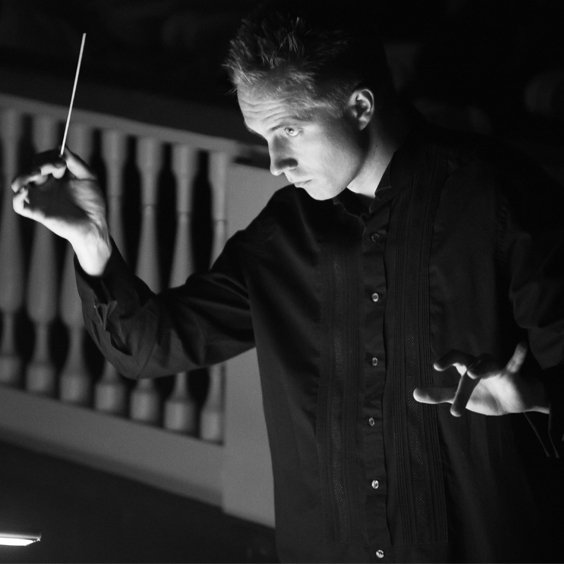
Inside the rehearsals for Eugene Onegin:
Vasily Petrenko
Vasily Petrenko, musical director and conductor:
“This is my fourth production of Eugene Onegin. I’ve directed the opera in the UK, France and the US, but this is the first time in Russia, and so it has a great significance for me. Onegin is a quintessentially Russian work, and I hope that I will be able to bring a faithful rendition of Tchaikovsky’s score to the stage of the Mikhailovsky Theatre here in St. Petersburg. I, together with the orchestra, the soloists and the choir, have been working painstakingly to bring out those expressive, rousing, and thematic intonations that the composer put into his opera. The libretto and melody of Onegin are syncretic; they are bound together inextricably. We hope to be able to illustrate the precise link between the two, as well as the organic nature of the emotion which pervades the work.”
“Compared to other works by Tchaikovsky, often heard on Moscow and St. Petersburg’s imperial stages, Onegin was originally conceived on a scale more akin to chamber music. Indeed, Tchaikovsky himself referred to the work as ‘lyric scenes’, rather than an opera. He wasn’t seeking extravagant or luxurious sets, but a heartfelt story; he didn’t want puppets but people, people with feelings, thoughts and troubles, who would resonate with the composer. This is evident not just in the libretto, but in the music as well. The orchestration of Eugene Onegin does in fact resemble chamber music; there’s almost no trumpet or trombone, and the main emphasis is on the string section, which transmits the tiniest movements of the soul. To really identify and convey all the colours and hues of the strings, to reflect the poetry of the music, requires the orchestra’s most meticulous and concerted efforts.”
“In the composer’s oeuvre, Eugene Onegin is among the works most closely associated with St. Petersburg. The opera is doubtless suffused with the Petersburg soul, and Onegin himself is a typical Petersburg dissident, talking a lot, contemplating and philosophizing, but actually doing very little, and always trying to keep himself at a distance from the society around him. A highly complex network of Petersburg leitmotifs has been woven into the opera, and I hope that we will successfully convey it to the audience.”