
10.06.2013
“Ballet is a nation all of its own”
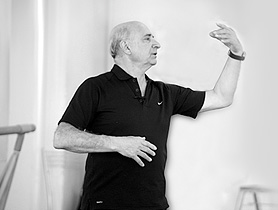
Leading ballet instructor Azari Plisetsky has conducted a series of open classes at the Mikhailovsky Theatre. Plisetsky, from a celebrated Moscow ballet dynasty, has worked primarily in the West for many years. For the past two decades, he has been a teacher and coach with the Béjart Ballet Lausanne. His experience combines classical ballet traditions with modern choreographic experimentation.
Having gained an impression of the Mikhailovsky company through working with the dancers, the maestro agreed to share his view of the main trends in ballet today. The conversation opened with a question about the main role of a ballet instructor. Is it to develop a dancer’s body or to strengthen their spirit?
“But why divide the two? Technique and aesthetics are like parallel lines that progress together. Focus only on technique and you will end up with robots. But focus only on expression and the structure is lost. It is exactly this balance that I try to maintain, and I talk about this throughout the class: there must be artistic expression and technique. Every move an artist makes is a definite statement of self-expression. Each step, each position of the head and shoulders — this is where expression lies; even in everyday movements of the body, a mood is communicated. I would not separate the emotional and technical sides of dance.
Each ballet company has its own unique spirit. This spirit depends first and foremost on the director, who determines the mood. I have worked with many ballet masters and I know the effect that leading choreographers have on their collaborators, who almost always adapt to the choreographer. I would not go so far as to say that this is a general rule. Let’s just say that with our company in Lausanne, I can feel and understand how it functions internally, but I am not saying that this should be a standard that others must follow. For this particular company, yes, it is a kind of standard, but to try and make it fit another company would be pointless. Béjart sought to collaborate with performers who quickly understood him and immediately adjusted to his way of thinking. It was a similar situation with Neumeier in Hamburg and with John Cranko. These masters surrounded themselves with like-minded people, and the special spirit they created remains today, even after their departure.
I have only just begun to get acquainted with the Mikhailovsky Theatre company. I love the fact that the artists are able to work on such a diverse repertoire. This is excellent for their development. And although not all of the dancers are capable of everything, each member of the company is given an opportunity, in both the modern and classical repertoire. The dancers are all very well trained, have all studied at great schools, and been taught by good professionals. If I watch closely, I can see that certain dancers grasp everything very quickly, while others learn more slowly, and this is natural. From different individuals, a unified dance company gradually takes shape, with a signature aesthetic and a characteristic style. But, again, it is through working on a repertoire that artists truly grow. The dance class is simply for fine tuning. In my estimation, the physical condition of the dancers is superb, as is their coordination. I watched Oksana Bondareva, who debuted in the title role in Romeo and Juliet. I thoroughly enjoyed it. She has such spontaneity in her movements, such freshness, as if a breeze accompanied her every move. It is very attractive.
The theatre is extremely lucky to have Mikhail Messerer. A true master with impeccable classical training, he preserves the heritage of ballet in its best form. Evidence of his influence can be found in the company’s enormous success abroad, where the dancers’ wonderful classical training did not go unnoticed. I can definitely sense this in the lessons: everything I ask is understood instantly, and an adequate response follows. The artists and I ‘speak the same language’.
In Lausanne, where I continue to work, there is a more one-sided orientation of the dancers towards the Béjart repertoire and style. Now that the company is directed by Gil Roman, who has added his own individual touches, the choreography does not resemble that of Béjart, and yet something of his style remains. I notice that the artists are bored of the classics and tend to ‘drift off’ in lessons on classical combinations. Kader Belarbi, who now directs the ballet in Toulouse, recently invited a girl from our company to perform the leading role in Le Corsaire. She had always dreamed of performing the classics, so she gladly agreed and danced brilliantly.
Ballet is a nation all of its own. Of course, we are accustomed to thinking that every national ballet school has its strengths and weaknesses, but nowadays, the borders are gradually being erased. Thanks to the Internet and a more intensive exchange of information, all choreographies are accessible and anyone can do anything. Or at least they think they can. And there are pros and cons to this; I call it ‘globalization’. Last summer, during a recording of Big Ballet on the Kultura TV channel, where I was on the jury, I asked Sergei Polunin where he learned Ben Van Cauwenberghe’s Les Bourgeois. “On Skype”, he answered. This was not possible before. There are pros and cons here, and I do not even know which outweighs the other. If you study with a certain performer, you involuntarily imitate him or her, repeating their mistakes. The choreographer loses the ability to control the performance; errors creep in as well as happy accidents.
The ballet artist sees everything, wants everything, and tries everything — and that’s great! But this has its dangers. The ties that have bound artists and their masters from time immemorial may be weakened. A dancer, no matter how talented, needs the eye of a third party. The dancer alone cannot determine whether a particular movement is being executed correctly. And this is why there is the concept of a school, in the highest sense: not a room full of pupils seated at desks, but the relationship between the teacher and the student, the teacher and the artist. In the sense we give to the word when we say, for example, ‘the Michelangelo school’.
But if you ask me whether the time has come for leading ballet schools to be placed under protection in the way that UNESCO protects architectural monuments, I am not sure how to answer. It’s debatable: people often cling to dogma, and then instead of tradition, dogmatism and rigidity prevail: “That’s just the way we were taught”. But ballet is one of the most dynamic art forms. Even in my lifetime it has evolved incredibly. The techniques and the aesthetics have changed, and even the morphology of the dancers is entirely different. It’s dangerous to cling to the preservation of tradition. What would Vaganova be doing today? Agrippina Vaganova evolved throughout her life. If Asaf Messerer were to come to my class, I think he would recognize the basic principles, but he would be open to everything that is new as well. I remember well how, when the Grand Opera first visited Moscow and we watched their classes, he very readily accepted changes and innovations, such as a movement of the foot or a subtle technique. And I am also interested in everything new. All teachers are open to new introductions within their discipline, unless they are rigid and disengaged from their work. I’m willing to look to the work of other teachers and to say “That is a correct choice, I should use that.” You are learning all your life.
Today, the opportunities for dancers who do not meet the high standards required by the classical traditions have expanded enormously. If they have sufficient talent and good coordination of movement, they can find their place and dance. Western companies have a simpler approach to this: whether dancers are taller or shorter, thinner or rounder, there is something for every one of them. Apart from classical dance, there is now modern dance, jazz, break dancing, street dance, and a huge number of other possibilities. There is no longer the magic there was before: if you come from St. Petersburg or Moscow, it does not mean that your professional standard is higher by definition. You can learn better and more precisely on the job. You can’t rest on your laurels, congratulating yourself on what you have achieved and what you can do. If an artist is clever, he or she will always improve. Farukh Ruzimatov attended my class at the Mikhailovsky Theatre — and he carried out every exercise so carefully!
I thought: that’s the key to a long career. Farukh and Leonid Sarafanov are people who are serious about their art. They realize that the only way forward is to demand a lot of themselves.
When I met Nacho Duato, we recalled how we first got to know each other. He studied under me as a dancer — he came to Béjart’s Mudra School in Brussels. Nacho immediately impressed me with his amazing gifts: splendid legs and arms, and what coordination! He was a wonderful dancer, but even then he was more interested in choreography. You could just tell that choreographing would be more interesting to him! And when he transferred to Kylián in The Hague, I was hardly surprised by his first production, Jardí tancat. I loved it, and I continued to follow his work as a choreographer with great pleasure. I am sincerely delighted that the artists of the Mikhailovsky Theatre have been given new opportunities for self-expression through contemporary dance.
Having gained an impression of the Mikhailovsky company through working with the dancers, the maestro agreed to share his view of the main trends in ballet today. The conversation opened with a question about the main role of a ballet instructor. Is it to develop a dancer’s body or to strengthen their spirit?
“But why divide the two? Technique and aesthetics are like parallel lines that progress together. Focus only on technique and you will end up with robots. But focus only on expression and the structure is lost. It is exactly this balance that I try to maintain, and I talk about this throughout the class: there must be artistic expression and technique. Every move an artist makes is a definite statement of self-expression. Each step, each position of the head and shoulders — this is where expression lies; even in everyday movements of the body, a mood is communicated. I would not separate the emotional and technical sides of dance.
Each ballet company has its own unique spirit. This spirit depends first and foremost on the director, who determines the mood. I have worked with many ballet masters and I know the effect that leading choreographers have on their collaborators, who almost always adapt to the choreographer. I would not go so far as to say that this is a general rule. Let’s just say that with our company in Lausanne, I can feel and understand how it functions internally, but I am not saying that this should be a standard that others must follow. For this particular company, yes, it is a kind of standard, but to try and make it fit another company would be pointless. Béjart sought to collaborate with performers who quickly understood him and immediately adjusted to his way of thinking. It was a similar situation with Neumeier in Hamburg and with John Cranko. These masters surrounded themselves with like-minded people, and the special spirit they created remains today, even after their departure.
I have only just begun to get acquainted with the Mikhailovsky Theatre company. I love the fact that the artists are able to work on such a diverse repertoire. This is excellent for their development. And although not all of the dancers are capable of everything, each member of the company is given an opportunity, in both the modern and classical repertoire. The dancers are all very well trained, have all studied at great schools, and been taught by good professionals. If I watch closely, I can see that certain dancers grasp everything very quickly, while others learn more slowly, and this is natural. From different individuals, a unified dance company gradually takes shape, with a signature aesthetic and a characteristic style. But, again, it is through working on a repertoire that artists truly grow. The dance class is simply for fine tuning. In my estimation, the physical condition of the dancers is superb, as is their coordination. I watched Oksana Bondareva, who debuted in the title role in Romeo and Juliet. I thoroughly enjoyed it. She has such spontaneity in her movements, such freshness, as if a breeze accompanied her every move. It is very attractive.
The theatre is extremely lucky to have Mikhail Messerer. A true master with impeccable classical training, he preserves the heritage of ballet in its best form. Evidence of his influence can be found in the company’s enormous success abroad, where the dancers’ wonderful classical training did not go unnoticed. I can definitely sense this in the lessons: everything I ask is understood instantly, and an adequate response follows. The artists and I ‘speak the same language’.
In Lausanne, where I continue to work, there is a more one-sided orientation of the dancers towards the Béjart repertoire and style. Now that the company is directed by Gil Roman, who has added his own individual touches, the choreography does not resemble that of Béjart, and yet something of his style remains. I notice that the artists are bored of the classics and tend to ‘drift off’ in lessons on classical combinations. Kader Belarbi, who now directs the ballet in Toulouse, recently invited a girl from our company to perform the leading role in Le Corsaire. She had always dreamed of performing the classics, so she gladly agreed and danced brilliantly.
Ballet is a nation all of its own. Of course, we are accustomed to thinking that every national ballet school has its strengths and weaknesses, but nowadays, the borders are gradually being erased. Thanks to the Internet and a more intensive exchange of information, all choreographies are accessible and anyone can do anything. Or at least they think they can. And there are pros and cons to this; I call it ‘globalization’. Last summer, during a recording of Big Ballet on the Kultura TV channel, where I was on the jury, I asked Sergei Polunin where he learned Ben Van Cauwenberghe’s Les Bourgeois. “On Skype”, he answered. This was not possible before. There are pros and cons here, and I do not even know which outweighs the other. If you study with a certain performer, you involuntarily imitate him or her, repeating their mistakes. The choreographer loses the ability to control the performance; errors creep in as well as happy accidents.
The ballet artist sees everything, wants everything, and tries everything — and that’s great! But this has its dangers. The ties that have bound artists and their masters from time immemorial may be weakened. A dancer, no matter how talented, needs the eye of a third party. The dancer alone cannot determine whether a particular movement is being executed correctly. And this is why there is the concept of a school, in the highest sense: not a room full of pupils seated at desks, but the relationship between the teacher and the student, the teacher and the artist. In the sense we give to the word when we say, for example, ‘the Michelangelo school’.
But if you ask me whether the time has come for leading ballet schools to be placed under protection in the way that UNESCO protects architectural monuments, I am not sure how to answer. It’s debatable: people often cling to dogma, and then instead of tradition, dogmatism and rigidity prevail: “That’s just the way we were taught”. But ballet is one of the most dynamic art forms. Even in my lifetime it has evolved incredibly. The techniques and the aesthetics have changed, and even the morphology of the dancers is entirely different. It’s dangerous to cling to the preservation of tradition. What would Vaganova be doing today? Agrippina Vaganova evolved throughout her life. If Asaf Messerer were to come to my class, I think he would recognize the basic principles, but he would be open to everything that is new as well. I remember well how, when the Grand Opera first visited Moscow and we watched their classes, he very readily accepted changes and innovations, such as a movement of the foot or a subtle technique. And I am also interested in everything new. All teachers are open to new introductions within their discipline, unless they are rigid and disengaged from their work. I’m willing to look to the work of other teachers and to say “That is a correct choice, I should use that.” You are learning all your life.
Today, the opportunities for dancers who do not meet the high standards required by the classical traditions have expanded enormously. If they have sufficient talent and good coordination of movement, they can find their place and dance. Western companies have a simpler approach to this: whether dancers are taller or shorter, thinner or rounder, there is something for every one of them. Apart from classical dance, there is now modern dance, jazz, break dancing, street dance, and a huge number of other possibilities. There is no longer the magic there was before: if you come from St. Petersburg or Moscow, it does not mean that your professional standard is higher by definition. You can learn better and more precisely on the job. You can’t rest on your laurels, congratulating yourself on what you have achieved and what you can do. If an artist is clever, he or she will always improve. Farukh Ruzimatov attended my class at the Mikhailovsky Theatre — and he carried out every exercise so carefully!
I thought: that’s the key to a long career. Farukh and Leonid Sarafanov are people who are serious about their art. They realize that the only way forward is to demand a lot of themselves.
When I met Nacho Duato, we recalled how we first got to know each other. He studied under me as a dancer — he came to Béjart’s Mudra School in Brussels. Nacho immediately impressed me with his amazing gifts: splendid legs and arms, and what coordination! He was a wonderful dancer, but even then he was more interested in choreography. You could just tell that choreographing would be more interesting to him! And when he transferred to Kylián in The Hague, I was hardly surprised by his first production, Jardí tancat. I loved it, and I continued to follow his work as a choreographer with great pleasure. I am sincerely delighted that the artists of the Mikhailovsky Theatre have been given new opportunities for self-expression through contemporary dance.