
04.10.2012
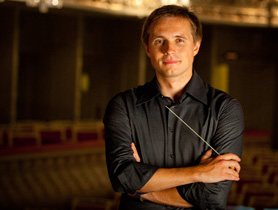
Vasily Petrenko – Artist of the Year
Vasily Petrenko has won the Male Artist award at the Classic BRIT Awards 2012. The awards ceremony was held in London’s Royal Albert Hall on 2 October.
This prestigious prize, the classical equivalent of the GRAMMY awards, was instituted by the British Recorded Music Industry (BPI) in 2000 as a mark of recognition of the achievements of classical performers and the worldwide growth in the popularity of classical music. The award is conferred annually in accordance with the results of a vote by a panel of experts, which includes representatives of the recording industry and specialized publications, members of the British Musicians’ Union, producers, and orchestra leaders. The only exception is the winner in the Album of the Year category, which is determined by a vote by Classic FM radio listeners.
This is the second time Vasily Petrenko has won a Classic BRIT Award: in 2010 the maestro was also voted best male artist for his recordings of Shostakovich’s symphonies. This year the conductor was competing in the category with such stars as the tenor Andrea Bocelli and the pianist Lang Lang. His success was due to the albums he recorded with the Royal Liverpool Philharmonic Orchestra on the Naxos, Avie, and EMI Classics labels. The CDs feature works by Shostakovich and Rachmaninoff.
Vasily Petrenko answered our questions immediately after the results were announced:
Vasily, please accept our warmest congratulations! This is the second time you have received this prestigious prize. Was the awards ceremony any different fr om when you won the Classic BRIT Award two years ago, or does it always follow the same strict ritual?
I can’t say anything about this year’s ceremony — I am conducting in San Francisco at the moment, so it was not possible for me to be in London. Two years ago it was all very much like the Oscars: a red carpet, reporters, fans, cameras, models, compères, and a spectacular show in front of a huge audience. This time I had to record my acceptance speech in advance: it was shown on a big screen in the Albert Hall. In fact, the Classic BRIT Awards is one of the most outstanding events in Britain and Europe, and captures people’s attention all over the world. It is a pity that it is not so widely covered in Russia.
The recordings for which you won the award were released on different labels. Were they recorded in a studio or live at concerts?
They were all recorded in the Royal Philharmonic Hall in Liverpool, wh ere the orchestra performs every week. Fortunately the acoustics there are wonderful — not only for concerts, but also for recordings of any complexity.
What influence do the major record labels have on the structure of musical life, in particular, on your conducting career? What percentage of your time do you devote to concert performances, and to work in the studio?
At the moment recordings are actually the best advertisement for the orchestra; they make it considerably easier to organize tours and to attract people from other cities and countries. They bring virtually no profit from a financial point of view; at best the sales cover expenses and the recording engineers’ fees. I try to release three or four CDs a year — it is not possible to do more on account of our contractual obligations to Naxos, with whom we have been recording the whole cycle of Shostakovich’s symphonies for several years.
Can we draw the conclusion that the British love Russian music, or are you consciously instilling that love in them? Is it possible to speak in general of the musical preferences of audiences in different countries?
The whole world loves Russian music! I am therefore very happy and grateful to Russian composers, who have composed a huge number of masterpieces that are recognized everywhere. I think the point is that music is a very emotional kind of art, and nobody can be as open in their emotions as we can. In Britain, though, along with Russian, Austro-German, and French music, naturally a great deal of British classical music is also performed, including works by Elgar, Britten, Walton, and other composers — each country has to support its own composers, its own culture.
This prestigious prize, the classical equivalent of the GRAMMY awards, was instituted by the British Recorded Music Industry (BPI) in 2000 as a mark of recognition of the achievements of classical performers and the worldwide growth in the popularity of classical music. The award is conferred annually in accordance with the results of a vote by a panel of experts, which includes representatives of the recording industry and specialized publications, members of the British Musicians’ Union, producers, and orchestra leaders. The only exception is the winner in the Album of the Year category, which is determined by a vote by Classic FM radio listeners.
This is the second time Vasily Petrenko has won a Classic BRIT Award: in 2010 the maestro was also voted best male artist for his recordings of Shostakovich’s symphonies. This year the conductor was competing in the category with such stars as the tenor Andrea Bocelli and the pianist Lang Lang. His success was due to the albums he recorded with the Royal Liverpool Philharmonic Orchestra on the Naxos, Avie, and EMI Classics labels. The CDs feature works by Shostakovich and Rachmaninoff.
Vasily Petrenko answered our questions immediately after the results were announced:
Vasily, please accept our warmest congratulations! This is the second time you have received this prestigious prize. Was the awards ceremony any different fr om when you won the Classic BRIT Award two years ago, or does it always follow the same strict ritual?
I can’t say anything about this year’s ceremony — I am conducting in San Francisco at the moment, so it was not possible for me to be in London. Two years ago it was all very much like the Oscars: a red carpet, reporters, fans, cameras, models, compères, and a spectacular show in front of a huge audience. This time I had to record my acceptance speech in advance: it was shown on a big screen in the Albert Hall. In fact, the Classic BRIT Awards is one of the most outstanding events in Britain and Europe, and captures people’s attention all over the world. It is a pity that it is not so widely covered in Russia.
The recordings for which you won the award were released on different labels. Were they recorded in a studio or live at concerts?
They were all recorded in the Royal Philharmonic Hall in Liverpool, wh ere the orchestra performs every week. Fortunately the acoustics there are wonderful — not only for concerts, but also for recordings of any complexity.
What influence do the major record labels have on the structure of musical life, in particular, on your conducting career? What percentage of your time do you devote to concert performances, and to work in the studio?
At the moment recordings are actually the best advertisement for the orchestra; they make it considerably easier to organize tours and to attract people from other cities and countries. They bring virtually no profit from a financial point of view; at best the sales cover expenses and the recording engineers’ fees. I try to release three or four CDs a year — it is not possible to do more on account of our contractual obligations to Naxos, with whom we have been recording the whole cycle of Shostakovich’s symphonies for several years.
Can we draw the conclusion that the British love Russian music, or are you consciously instilling that love in them? Is it possible to speak in general of the musical preferences of audiences in different countries?
The whole world loves Russian music! I am therefore very happy and grateful to Russian composers, who have composed a huge number of masterpieces that are recognized everywhere. I think the point is that music is a very emotional kind of art, and nobody can be as open in their emotions as we can. In Britain, though, along with Russian, Austro-German, and French music, naturally a great deal of British classical music is also performed, including works by Elgar, Britten, Walton, and other composers — each country has to support its own composers, its own culture.