
26.10.2018
The Musical World of Romanticism
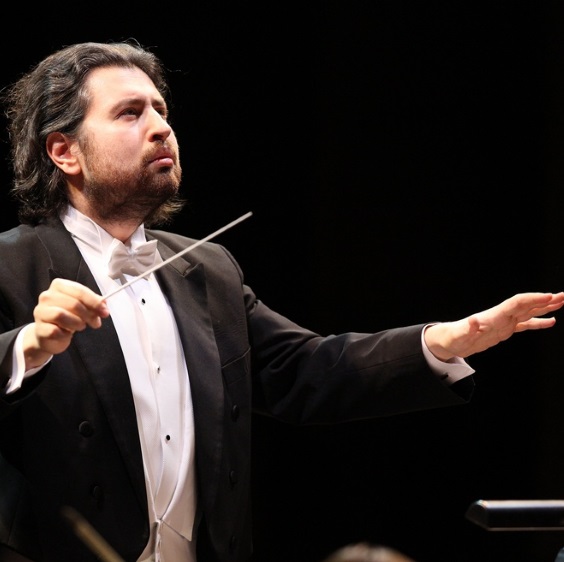
On 3 November, the Symphony Orchestra of the Mikhailovsky Theatre will give a concert in the Grand Philharmonic Hall. Audiences can look forward to an encounter with some of the masterpieces of the classical canon. The concert will open with one of the suites from Grieg’s Peer Gynt and Tchaikovsky’s Variations on a Rococo Theme, while the second half will include fragments of Bizet’s music for L’Arlésienne, Liszt’s Mephistopheles, and Ravel’s choreographic poem La Valse. Dmitri Jurowski, member of a legendary musical dynasty, has provided this short commentary as a preface to the concert which he will be conducting on the night.
"Maybe it’s in our genes. Just like my father and my brother, I believe that music is something we should talk about. I take any opportunity to try to communicate with the audience about the compositions being performed — and I will certainly be doing that at our upcoming concert in the Grand Philharmonic Hall. The emphasis will be on the waltzes by Liszt and Ravel, which I decided to add to the programme. These form very logical and natural accompaniments to L’Arlésienne: after all, they have something in common. This shared characteristic is a certain plasticity. It’s no coincidence that the music for L’Arlésienne, although it was created for a play and not for a ballet, is often used by choreographers, and that several choreographed versions of it exist. On the other hand, although it might seem that Liszt’s and Ravel’s waltzes were composed at a time when the waltz was primarily dance music, these pieces show the waltz in an entirely different light: they have a history and a theatrical background to them. This kind of information isn’t always easy to find and read up on, but this is what I want to talk to the audience about at the concert. Music can be listened to in different ways. I’ve experienced this for myself several times: when I talk to an audience about music that I’m performing, they listen to it differently. I’ve spoken about Liszt’s and Ravel’s waltzes in Russia alone four times already, in Moscow and Novosibirsk, and another four times in different European countries: Italy, Germany, and Belgium. This can be useful for audiences, helping to alter their perception of the music, especially at a concert with such a packed programme. I see the programme as an introduction to the musical world of romanticism, from different perspectives — a Slavonic perspective, a Germanic perspective, and a Francophone perspective. I’m not talking here about the nationality of the composers. In the musical poetics of Grieg, for example, you can find Slavonic motifs, just as you can find German motifs in Tchaikovsky. I am particularly enjoying my preparation for this upcoming concert, where I will be adding a few of my own words to this wonderful music, attempting to express my own personal understanding of it."
"Maybe it’s in our genes. Just like my father and my brother, I believe that music is something we should talk about. I take any opportunity to try to communicate with the audience about the compositions being performed — and I will certainly be doing that at our upcoming concert in the Grand Philharmonic Hall. The emphasis will be on the waltzes by Liszt and Ravel, which I decided to add to the programme. These form very logical and natural accompaniments to L’Arlésienne: after all, they have something in common. This shared characteristic is a certain plasticity. It’s no coincidence that the music for L’Arlésienne, although it was created for a play and not for a ballet, is often used by choreographers, and that several choreographed versions of it exist. On the other hand, although it might seem that Liszt’s and Ravel’s waltzes were composed at a time when the waltz was primarily dance music, these pieces show the waltz in an entirely different light: they have a history and a theatrical background to them. This kind of information isn’t always easy to find and read up on, but this is what I want to talk to the audience about at the concert. Music can be listened to in different ways. I’ve experienced this for myself several times: when I talk to an audience about music that I’m performing, they listen to it differently. I’ve spoken about Liszt’s and Ravel’s waltzes in Russia alone four times already, in Moscow and Novosibirsk, and another four times in different European countries: Italy, Germany, and Belgium. This can be useful for audiences, helping to alter their perception of the music, especially at a concert with such a packed programme. I see the programme as an introduction to the musical world of romanticism, from different perspectives — a Slavonic perspective, a Germanic perspective, and a Francophone perspective. I’m not talking here about the nationality of the composers. In the musical poetics of Grieg, for example, you can find Slavonic motifs, just as you can find German motifs in Tchaikovsky. I am particularly enjoying my preparation for this upcoming concert, where I will be adding a few of my own words to this wonderful music, attempting to express my own personal understanding of it."