
Sergei Prokofiev: acclaimed and unknown
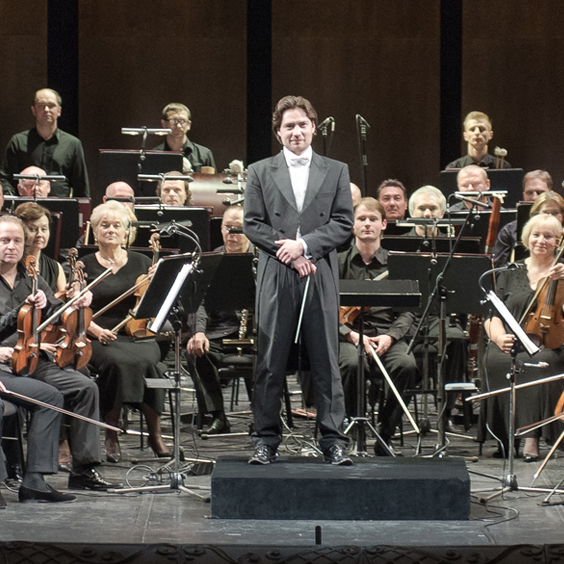
On 23 April, the musical world will mark the 125th anniversary of Sergei Prokofiev’s birth. Maestro Mikhail Tatarnikov and the Mikhailovsky Theatre Symphony Orchestra have put together a unique programme, dedicated to one of the twentieth century’s greatest composers. Along with The Scythian Suite, acknowledged as a masterpiece with which the Russian genius challenged the music world, the programme will also include extremely rarely heard works: symphonic poem Dreams, the Russian Overture, symphonic suite The Year 1941, and Andante from Piano Sonata No. 4 in a special transcription for orchestra.
“We thought long and hard about the programme for the Prokofiev concert”, says Mikhail Tatarnikov. “I am sure that it will draw the attention of a wide audience, including the most discerning. I will simply state one fact: it suffices to say that the score for Dreams, composed in 1910, remains unpublished; the notation for this work was generously provided for the concert at the Mikhailovsky Theatre by the conductor Gennady Rozhdestvensky, one of the most loyal advocates of Prokofiev’s work.”
Musicologist Vladimir Goryachikh, Associate Professor at the St. Petersburg State Conservatory and St. Petersburg State University was involved in putting together the programme.
“The programme covers almost the entire artistic career of the composer. The concert will feature both early works (the music which became Andante from Piano Sonata No. 4 emerged as early as 1908) and works composed at the end of his life, such as the two Pushkin Waltzes, Prokofiev’s lyrical masterpieces written in 1949 to mark the 150th anniversary of Alexander Pushkin’s birth”, says Goryachikh.
“And it is very important to recognize”, he continues, “that almost all of the works to be performed by the Mikhailovsky Theatre Orchestra, were either subjected to unfair criticism at the time of their creation and during the first performances, or were almost entirely overlooked, a fact which is reflected in their fate. They would eventually be overshadowed by Prokofiev’s symphonies and other renowned symphonic opuses. In many ways, this was because of their discord with the ‘well-trodden’ style of Prokofiev’s more famous works, exemplified by the composition of the programme we have put together. Today, however, it is these elements which allow us to broaden our understanding of the composer’s creative approach, and to appreciate its richness and diversity. Every composition of Prokofiev’s that we have included in the programme bears the mark of his genius, and will enrapture audiences with its mastery and limitless ingenuity. It goes without saying that every one of them deserves a long and happy life on the stage.”