
05.10.2012
Principal Conductor’s Choice
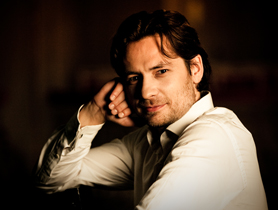
There are many opera houses around the world where the orchestras give symphony concerts, and the Mikhailovsky Theatre is maintaining this tradition: on 14 October there will be a concert featuring the theatre’s choir and orchestra. Mikhail Tatarnikov, the Mikhailovsky Theatre’s Musical Director and Principal Conductor, describes how the programme for the concert took shape.
"All good theatre orchestras perform symphony works. Any self-respecting theatre — in Russia, Europe, or the rest of the world — is expected, even obliged to give symphony concerts. It is not only important for the theatre’s image; it is also interesting for the musicians. When a theatre orchestra comes out of the pit and goes on stage, it communicates with the audience on an entirely different level. A good example for everyone is the Vienna Philharmonic Orchestra, which performs both opera and symphony music; an ‘exchange’ of that kind is absolutely essential.
When I was compiling the programme for the concert, I chose the works on a very simple principle: it was all music that I very much wanted to perform. I have always dreamed of conducting Sergey Taneyev’s cantata St. John of Damascus; it is a real masterpiece that is performed extremely rarely. I have already conducted the cantata Spring and I really like it; in general, Rachmaninoff is one of my favourite composers. I have been thinking about performing the cantata again for a long time, and I have carefully prepared and rehearsed it. As for Dvořák, there was never a moment’s hesitation: his Symphony No. 9 (From the New World) is a classic of the world repertoire, a really great symphony. I have a kind of special inner link with Dvořák. Quite a long time ago, I conducted the Novosibirsk Philharmonic Chamber Orchestra in a performance of his Serenade for Strings, and I made my debut in Turin with his opera Rusalka. I am very drawn to Dvořák’s music.
On 14 October we are staging a grand symphony concert. I do not mean performing individual works, but rather a fully-fledged programme. When I was putting it together, I was thinking what music would best suit our wonderful choir and orchestra. We will be performing interesting, striking, and great works. Going back to St. John of Damascus, for instance, if you delve into the account of this saint’s life, you can see complex themes full of elements that are strikingly relevant today. There are many myths about St. John of Damascus, but the important thing is that he drew up a code of rules for the Christian faith at a time of religious chaos in the Middle East. He wrote religious music, but unfortunately those hymns have not survived, as at that time there was not yet a musical notation system. Delving into all this is fascinating, and it is very interesting work for the choir and orchestra, if it is well performed. And I have no doubt that it will be: our choir has always been renowned for its brilliant standards, and in the last few months the orchestra has discovered and liberated itself in terms of performance skill and quality of sound; it is taking on a real brilliance and lustre in performance. We are rehearsing very diligently, including, of course, a few encores, but those will be a surprise".
"All good theatre orchestras perform symphony works. Any self-respecting theatre — in Russia, Europe, or the rest of the world — is expected, even obliged to give symphony concerts. It is not only important for the theatre’s image; it is also interesting for the musicians. When a theatre orchestra comes out of the pit and goes on stage, it communicates with the audience on an entirely different level. A good example for everyone is the Vienna Philharmonic Orchestra, which performs both opera and symphony music; an ‘exchange’ of that kind is absolutely essential.
When I was compiling the programme for the concert, I chose the works on a very simple principle: it was all music that I very much wanted to perform. I have always dreamed of conducting Sergey Taneyev’s cantata St. John of Damascus; it is a real masterpiece that is performed extremely rarely. I have already conducted the cantata Spring and I really like it; in general, Rachmaninoff is one of my favourite composers. I have been thinking about performing the cantata again for a long time, and I have carefully prepared and rehearsed it. As for Dvořák, there was never a moment’s hesitation: his Symphony No. 9 (From the New World) is a classic of the world repertoire, a really great symphony. I have a kind of special inner link with Dvořák. Quite a long time ago, I conducted the Novosibirsk Philharmonic Chamber Orchestra in a performance of his Serenade for Strings, and I made my debut in Turin with his opera Rusalka. I am very drawn to Dvořák’s music.
On 14 October we are staging a grand symphony concert. I do not mean performing individual works, but rather a fully-fledged programme. When I was putting it together, I was thinking what music would best suit our wonderful choir and orchestra. We will be performing interesting, striking, and great works. Going back to St. John of Damascus, for instance, if you delve into the account of this saint’s life, you can see complex themes full of elements that are strikingly relevant today. There are many myths about St. John of Damascus, but the important thing is that he drew up a code of rules for the Christian faith at a time of religious chaos in the Middle East. He wrote religious music, but unfortunately those hymns have not survived, as at that time there was not yet a musical notation system. Delving into all this is fascinating, and it is very interesting work for the choir and orchestra, if it is well performed. And I have no doubt that it will be: our choir has always been renowned for its brilliant standards, and in the last few months the orchestra has discovered and liberated itself in terms of performance skill and quality of sound; it is taking on a real brilliance and lustre in performance. We are rehearsing very diligently, including, of course, a few encores, but those will be a surprise".