
08.08.2012
Premiere of Laurencia 5.06–6.06.2010
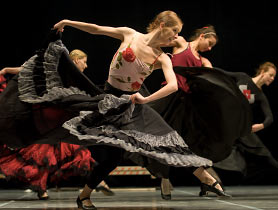
On June, 5 and 6 the Mikhailovsky Theatre is presenting a ballet premiere. To celebrate the centenary from the birth of the great choreographer Vakhtang Chabukiani the theatre has revived his legendary ballet Laurencia.
Vladimir Kekhman, General Director of the Mikhailovsky Theatre is sure that the academic theatre should have a diverse, prolific repertoire that includes the best works of different styles and epochs. ‘Chabukiani’s choreography is astonishingly viable. In spite of all the strict esthetic restrictions during the Stalin’s regime, he managed to keep the artistry and spirituality of dance. One can stress either social or interpersonal conflict in the ballet; however, the main features of Laurencia are emotionality, staginess and the polyphony of drama and dance.’
Vakhtang Chabukiani’s masterpiece was revived by the Mikhailovsky Theatre’s Ballet Master in Chief Mikhail Messerer. An expert in ballet history, he added to this production temps and dynamics of a modern theatre. ‘The ballet belongs to the special layer of our choreography, so called ‘Stalin’s classicism’, which boasts effects and luxury, theatricality in the most dignified and at the same time simple-minded sense of the word. It’s our cultural heritage. The Mikhailovsky Theatre has undertaken a mission of reviving the unique ballet, thus reminding of the whole period in development of dance.’
Laurencia is based on Lope de Vega’s drama Fuente Ovejuna and set to the upbeat music by Alexander Krein. It was premiered in 1939 at the Kirov Theatre. The role of Laurencia was performed by Natalia Dudinskaya while Vakhtang Chabukiani himself danced Frondoso. The ballet was highly suitable for the fiery temperament of this greate male dancer, who created his own particular blend of folk dance and classical ballet in Laurencia.
Against the background of virtuoso solos and duets, harmonious ensembles, arresting crowd scenes a dramatic story unfolds in which the joy of mutual love is broken by the violence responded to by the bursting of people’s rage.
Vladimir Kekhman, General Director of the Mikhailovsky Theatre is sure that the academic theatre should have a diverse, prolific repertoire that includes the best works of different styles and epochs. ‘Chabukiani’s choreography is astonishingly viable. In spite of all the strict esthetic restrictions during the Stalin’s regime, he managed to keep the artistry and spirituality of dance. One can stress either social or interpersonal conflict in the ballet; however, the main features of Laurencia are emotionality, staginess and the polyphony of drama and dance.’
Vakhtang Chabukiani’s masterpiece was revived by the Mikhailovsky Theatre’s Ballet Master in Chief Mikhail Messerer. An expert in ballet history, he added to this production temps and dynamics of a modern theatre. ‘The ballet belongs to the special layer of our choreography, so called ‘Stalin’s classicism’, which boasts effects and luxury, theatricality in the most dignified and at the same time simple-minded sense of the word. It’s our cultural heritage. The Mikhailovsky Theatre has undertaken a mission of reviving the unique ballet, thus reminding of the whole period in development of dance.’
Laurencia is based on Lope de Vega’s drama Fuente Ovejuna and set to the upbeat music by Alexander Krein. It was premiered in 1939 at the Kirov Theatre. The role of Laurencia was performed by Natalia Dudinskaya while Vakhtang Chabukiani himself danced Frondoso. The ballet was highly suitable for the fiery temperament of this greate male dancer, who created his own particular blend of folk dance and classical ballet in Laurencia.
Against the background of virtuoso solos and duets, harmonious ensembles, arresting crowd scenes a dramatic story unfolds in which the joy of mutual love is broken by the violence responded to by the bursting of people’s rage.