
09.08.2012
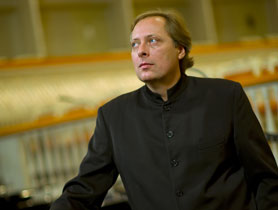
Peter Feranec will perform in the Great Philharmonic Hall
Peter Feranec, musical director and principal conductor of the Mikhailovsky Theatre, will perform in the Great Philharmonic Hall on April, 14. The symphonic orchestra and the Mikhailovsky Chorus under the baton of Peter Feranec will perform Stabat Mater by Antonín Dvořák.
Antonín Dvořák(1841-1904) is a Czech composer, the author of numerous instrumental and vocal pieces, along with Bedřich Smetana is considered to be the founder of the national music school.
Stabat Mater, the magnificent and sorrowful piece for orchestra and choir, is a summit in the creative activity of the composer. The composing of the cantata was Dvořák’s reaction to the death of his daughter Josefa. He returned to the final stylisation of the composition in 1877, when two of his children (the rest that were alive at that time) died within a short time of each other. The definitive version of the score was written in 1877 in Prague. It was the first piece by Dvořák performed abroad — in 1883 in London it received great critical acclaim.
Stabat Mater is Dvořák’s first work on a religious theme. It is divided into ten individual parts; only the first and the last part are thematically connected. Dvořák was among many composers, including Palestrina, Haydn, Mozart, Schubert, Rossini and Poulenc, to put Stabat Mater to music, but his version stands out with its extraordinary spiritual intensity and emotional range, as well as a strongly symphonic quality.
Antonín Dvořák
Stabat Mater, the magnificent and sorrowful piece for orchestra and choir, is a summit in the creative activity of the composer. The composing of the cantata was Dvořák’s reaction to the death of his daughter Josefa. He returned to the final stylisation of the composition in 1877, when two of his children (the rest that were alive at that time) died within a short time of each other. The definitive version of the score was written in 1877 in Prague. It was the first piece by Dvořák performed abroad — in 1883 in London it received great critical acclaim.
Stabat Mater is Dvořák’s first work on a religious theme. It is divided into ten individual parts; only the first and the last part are thematically connected. Dvořák was among many composers, including Palestrina, Haydn, Mozart, Schubert, Rossini and Poulenc, to put Stabat Mater to music, but his version stands out with its extraordinary spiritual intensity and emotional range, as well as a strongly symphonic quality.