
The music of Alexey Rybnikov
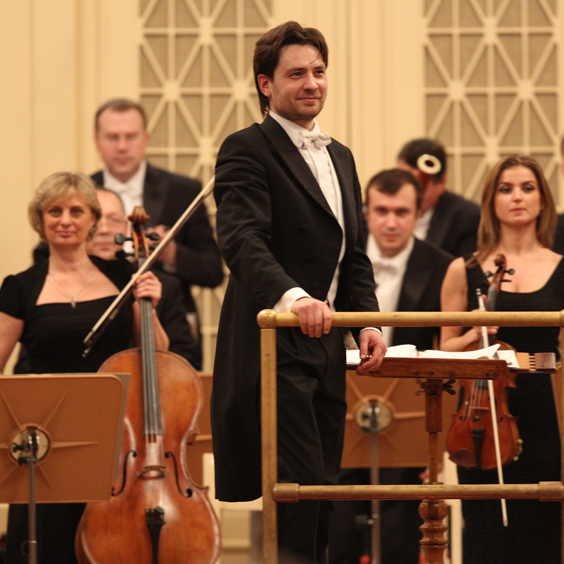
On 6 April, the Mikhailovsky Theatre’s symphony orchestra will perform at the Grand Hall of the St Petersburg Philharmonic. Conducted by Mikhail Tatarnikov, the orchestra will present a compilation of works by People’s Artist of Russia Alexey Rybnikov.
It is no exaggeration to say that the composer, who last year celebrated his 50th year of musical creativity, has garnered fame throughout the nation. In fact, just a few examples of Rybnikov’s work for film and TV are enough to confirm his status as a household name in Russia: the musical theme to the Yeralash children’s comedy show (Boys and Girls, and Their Parents Too); a platinum-selling album of songs from the animated feature The Adventures of Buratino; the soundtrack for the TV film That Very Same Munchausen; and the legendary rock-opera Juno and Avos. But in addition to the music he created for films, cartoons and musical theatre, Rybnikov has also written a number of symphonic works. The concert held in his honour on 6 April, as part of the fifth season of Lenten Concerts, will feature his works in academic genres, including Symphony No. 6 (Sinfonia Tenebrosa), the Night Song Capriccio for Violin and Orchestra, and Music of Lycia. Rybnikov himself will be playing the piano and organ, whilst soloist Ivan Pochekin will be playing the violin.
With this momentous event just around the corner, the composer gave an interview in which he talked about how the concert programme was devised. Below are some brief excerpts from the as-yet unpublished transcript.
Alexey Rybnikov: “Symphony No. 6 is the second instalment in a large cycle revolving around spiritual themes. Subtitled Sinfonia Tenebrosa — the dark symphony — it traces the emergence of evil in the world. It’s a four-part symphony, and each part has its own name. Part one is called ‘The Metamorphosis of the Angel of Light’, because evil, as we all know, was born within the Angel of Light, Lucifer... Part two, ‘Toccata Macabre’, tells of the rebellion of the forces of evil, and the declaration of war against the forces of light. Part three, ‘Sarabande Angelica’, is the mournful dance of an angel lamenting the fate of his brethren, who have been transformed from angels of light into forces of darkness. And finally, Part four, ‘Plunging into Darkness’, tells the story of the victory over the forces of evil and the triumph of the divine essence. Most importantly, at the end of the symphony, the first man — Adam — is born, emerging in the aftermath of the war between light and darkness. A new page of the story of the world is written.”
And this is what Rybnikov has to say about his Music of Lycia:
“Today, Lycia is a region of Turkey, but once upon a time it was an ancient state, which maintained its autonomy throughout Roman, Byzantine and Ottoman rule. For me, Lycia, with its rich, ancient culture, is one of the greatest places on earth. St. Nicholas lived and preached there... It is a land of tremendous history and powerful roots. Incidentally, the saint after whom I am named, Alexis the Man of God, also lived in Turkey. He spent a lot of time in Edessa, a place which today is the small town of Şanlıurfa, but which was once a major spiritual centre. I have a small house there in the mountains, in a beautifully secluded spot. It was there, in an isolated setting conducive to creativity, that I wrote Music of Lycia, in which the unique environment inspired strange imagery related to the struggle between light and darkness.”