
16.04.2019
“Listen, Leningrad”
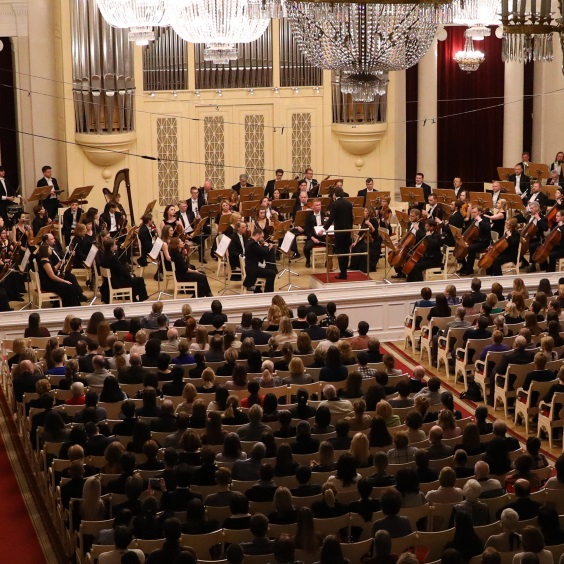
On 1 May, the Mikhailovsky Theatre Symphony Orchestra will be giving a concert in the Grand Hall of the St. Petersburg Philharmonic. The programme will be exactly the same as it was on 1 May 1942, when the Grand Hall reopened after the ordeal that was the first winter of the Siege of Leningrad.
The prominent music historian Andrey Kryukov, author of The Musical Life of Leningrad at War and Music within the Blockade, has pieced together scattered information about one of the most important events in the city’s musical history. He believes that 1 May 1942 marked the revival of Leningrad’s musical life, when the city came alive with Russian folk songs, Soviet songs, rhymes, and excerpts from operettas. The Musical Comedy Theatre staged Wedding in Malinovka (a press photographer managed to capture a scene at the entrance to the theatre, where a „spare ticket“ was being bought), an operetta ensemble performed Sylva in Kronstadt (the show went on even during an enemy air raid), and the Red Army Song and Dance Ensemble performed in the Red Army House. But the main event was the concert at the Philharmonia, which was broadcast on the radio so the whole of Leningrad could hear it. In the first half, the orchestra under Karl Eliasberg played the suite from Swan Lake and accompanied soloists in arias from Mazepa and Iolanta. The second half featured Tchaikovsky’s Fifth Symphony. „The symphony’s final march is wonderful. It would be good to pass under the Brandenburg Gate to that march,“ wrote architect Sergey Permut in his diary.
It was a busy day for all of Leningrad’s musicians. From a letter sent from within the besieged Leningrad, we know how violinist Viktor Zavetnovsky spent his day. Earlier he had complained that he felt weak and unwell, with overworked hands and boils on his fingers, but with the revival of Leningrad’s concert scene, he found a new lease of life. On 1 May he got up at 5am to get all his housework done, at 8.30 he was rehearsing with a pianist, at 10.15 the rehearsal for the evening concert began at the Philharmonia, at 1pm he played in a hospital, and at 5pm he performed in a military unit. At 7pm he was sitting behind his desk in the Philharmonia’s violin section. „I was driven to the concert at 5pm, but all the rest was on foot,“ he wrote. Nevertheless, his playing of the solo in the suite from Swan Lake, which had been entrusted to him, was, by his own assessment, „very successful“. His wife, who was listening to the concert on the radio, agreed: „It came across extremely well.“ It probably helped that the musician had been well fed over the course of the day, as he also mentioned in his letter.
Performing this historic programme on this day of remembrance is a great honour and responsibility for the Mikhailovsky Theatre Symphony Orchestra. The orchestra will be conducted by Valentin Uryupin, one of our most talented young conductors and winner of international competitions, who was recently awarded the Russian President’s Prize for young cultural personalities.
The prominent music historian Andrey Kryukov, author of The Musical Life of Leningrad at War and Music within the Blockade, has pieced together scattered information about one of the most important events in the city’s musical history. He believes that 1 May 1942 marked the revival of Leningrad’s musical life, when the city came alive with Russian folk songs, Soviet songs, rhymes, and excerpts from operettas. The Musical Comedy Theatre staged Wedding in Malinovka (a press photographer managed to capture a scene at the entrance to the theatre, where a „spare ticket“ was being bought), an operetta ensemble performed Sylva in Kronstadt (the show went on even during an enemy air raid), and the Red Army Song and Dance Ensemble performed in the Red Army House. But the main event was the concert at the Philharmonia, which was broadcast on the radio so the whole of Leningrad could hear it. In the first half, the orchestra under Karl Eliasberg played the suite from Swan Lake and accompanied soloists in arias from Mazepa and Iolanta. The second half featured Tchaikovsky’s Fifth Symphony. „The symphony’s final march is wonderful. It would be good to pass under the Brandenburg Gate to that march,“ wrote architect Sergey Permut in his diary.
It was a busy day for all of Leningrad’s musicians. From a letter sent from within the besieged Leningrad, we know how violinist Viktor Zavetnovsky spent his day. Earlier he had complained that he felt weak and unwell, with overworked hands and boils on his fingers, but with the revival of Leningrad’s concert scene, he found a new lease of life. On 1 May he got up at 5am to get all his housework done, at 8.30 he was rehearsing with a pianist, at 10.15 the rehearsal for the evening concert began at the Philharmonia, at 1pm he played in a hospital, and at 5pm he performed in a military unit. At 7pm he was sitting behind his desk in the Philharmonia’s violin section. „I was driven to the concert at 5pm, but all the rest was on foot,“ he wrote. Nevertheless, his playing of the solo in the suite from Swan Lake, which had been entrusted to him, was, by his own assessment, „very successful“. His wife, who was listening to the concert on the radio, agreed: „It came across extremely well.“ It probably helped that the musician had been well fed over the course of the day, as he also mentioned in his letter.
Performing this historic programme on this day of remembrance is a great honour and responsibility for the Mikhailovsky Theatre Symphony Orchestra. The orchestra will be conducted by Valentin Uryupin, one of our most talented young conductors and winner of international competitions, who was recently awarded the Russian President’s Prize for young cultural personalities.