
12.09.2012
Daniel Barenboim: “They invited me, and I said yes”
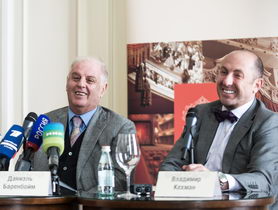
Daniel Barenboim spoke at a press conference at the Mikhailovsky Theatre on 10 September. The internationally renowned conductor, General Music Director and Principal Conductor of the Teatro alla Scala and the Staatsoper Unter den Linden and Staatskapelle Berlin, announced that in a year’s time, on 5–6 September 2013, he will perform here with the Staatskapelle orchestra. These concerts will be an important feature of the programme commemorating the 180th anniversary of the Mikhailovsky Theatre.
Maestro Barenboim, who is at the Mikhailovsky Theatre for the first time, noted that the theatre is “astoundingly beautiful, and is, in itself, an invitation to music”. For now, the conductor is keeping the programme for his St. Petersburg concerts under wraps, “for two reasons”, he says. Firstly, “it’s too early for you to be thinking about that”, and secondly, “it hasn’t been settled upon yet”. “I am absolutely certain that the Berlin musicians will bring us an excellent programme”, said Mikhailovsky Theatre General Director Vladimir Kekhman, suggesting that Wagner would almost certainly be featured at the concerts, as “next year is a special year: the 200th anniversary of the composer’s birth”. Barenboim does not rule out the possibility that his concerts “may be the prelude to something bigger”, and that he “might want to work in the pit”, that is, that he might conduct an opera at the Mikhailovsky. To the question of whether it had been difficult to come to an agreement on the performances, the maestro replied simply, “They invited me, and I said yes”.
Many threads connect Barenboim to Russia: he was born in Argentina, but all of his grandparents were Russian emigrants, and he also has a Russian wife. He noted that he had “never been to St. Petersburg”, but that he had been to Leningrad “a very long time ago; the last time was in 1984”. The city, with its special, rarified beauty, is associated in the maestro’s mind first and foremost with the name of Evgeny Mravinsky. Mravinsky’s work, which Barenboim first heard in 1962, made an unforgettable impression on him; Barenboim says that Mravinsky was “the most outstanding conductor of the 20th century”, alongside Furtwängler.
The press conference touched upon a number of questions. Specifically, the maestro shared his thoughts on how the state and private financial institutions should work together in order to support music and concerts. As Barenboim has vast experience working with music groups in the USA and Europe, and the differences between the continents in this sense are quite substantial, his point of view is of particular value. The maestro is convinced that, notwithstanding the importance of private initiatives, the state cannot step away from this task as, in the end, it is the state that is responsible to society for the promulgation of cultural values. He especially emphasized that music should not be considered an elite art (“Only those who know nothing about it could think that”). “Music is what determines the quality of life of society as a whole, and of all its members”.
Maestro Barenboim, who is at the Mikhailovsky Theatre for the first time, noted that the theatre is “astoundingly beautiful, and is, in itself, an invitation to music”. For now, the conductor is keeping the programme for his St. Petersburg concerts under wraps, “for two reasons”, he says. Firstly, “it’s too early for you to be thinking about that”, and secondly, “it hasn’t been settled upon yet”. “I am absolutely certain that the Berlin musicians will bring us an excellent programme”, said Mikhailovsky Theatre General Director Vladimir Kekhman, suggesting that Wagner would almost certainly be featured at the concerts, as “next year is a special year: the 200th anniversary of the composer’s birth”. Barenboim does not rule out the possibility that his concerts “may be the prelude to something bigger”, and that he “might want to work in the pit”, that is, that he might conduct an opera at the Mikhailovsky. To the question of whether it had been difficult to come to an agreement on the performances, the maestro replied simply, “They invited me, and I said yes”.
Many threads connect Barenboim to Russia: he was born in Argentina, but all of his grandparents were Russian emigrants, and he also has a Russian wife. He noted that he had “never been to St. Petersburg”, but that he had been to Leningrad “a very long time ago; the last time was in 1984”. The city, with its special, rarified beauty, is associated in the maestro’s mind first and foremost with the name of Evgeny Mravinsky. Mravinsky’s work, which Barenboim first heard in 1962, made an unforgettable impression on him; Barenboim says that Mravinsky was “the most outstanding conductor of the 20th century”, alongside Furtwängler.
The press conference touched upon a number of questions. Specifically, the maestro shared his thoughts on how the state and private financial institutions should work together in order to support music and concerts. As Barenboim has vast experience working with music groups in the USA and Europe, and the differences between the continents in this sense are quite substantial, his point of view is of particular value. The maestro is convinced that, notwithstanding the importance of private initiatives, the state cannot step away from this task as, in the end, it is the state that is responsible to society for the promulgation of cultural values. He especially emphasized that music should not be considered an elite art (“Only those who know nothing about it could think that”). “Music is what determines the quality of life of society as a whole, and of all its members”.